Grief

Chex Mix

In today’s version of The Skimm, I clicked the link about the rising cost of Diet Coke. The writer interviewed someone who drank 4-5 cans a day, and their wallet was feeling it. I puffed up my chest for just a moment, because while I love the vice that is Diet Coke, I certainly don’t drink four cans a day. Don’t we know that aspartame is bad for us! And then my smugness dissipated as I went to pour my third cup of coffee.

Each week I’ve been watching the price of bacon jump up – last time I checked a pound had gone up a dollar fifty since I started paying attention in October. Inflation isn’t new – we’re talking about it, we’re feeling the impacts, we’re curious about what’s going to go up in cost next.

And, we use our little vices to keep discomfort at bay. November turned to December quickly, and days were filled with meetings, meal planning, perhaps paying too much attention to the rising cost of things. And in my conversations with friends and family, shifts and changes continue to happen as the world rumbles across the ocean. One friend is quitting her job, another trying desperately to get pregnant. Kitchens are getting remodeled, grandparents moving to nursing homes, and our neighbors got Covid again.

I told Dylan last night I’m having a hard time filling my container with my own worries. I’ve gotten porous again, taking on the fears and hurts of others because I just want the world to stop. being. in. so. much. pain. And then I wonder, is it the world’s pain, or my own?

This weekend I got out my mom’s splattered recipes and stocked up on Chex Mix supplies. I poured dry cereal, pretzels, and nuts into my grandmother’s old roasting pan. I melted the butter, found the Worcestershire sauce, added salt and poured the hot liquid over the mess of carbs. I let baby stir, and together, we watched comfort soak into the open spaces in the cereal. Nuts became glossy and we stuck the pan into the oven to bake slowly, with intention.

Once done, I scooped the mix into Ball jars and sent the gifts out into the world with love.

Perhaps it’s silly to connect Chex Mix to love, the pouring of fats onto cereal as a way to rub balm into our wounds. When things are shifting, I turn to the kitchen. Salt helps. Butter is consistent. Let’s fill up our holes with love this season. We need each other.

May your snacks be salty, full of butter, and of love. Chex Mix – that, too, a beautiful thing.
Melancholy Or ….

On Halloween, I found myself awash in the mixture of my life. As I walked our little downtown’s streets, holding hands with a baby Elmo, I missed my dad with a well-worn, familiar ache. And I looked up to blue skies, and noticed an older gentleman sitting on a bench, holding up a Jack Russel Terrier to his face for a kiss. Golden leaves were falling, and with their descent came another landing truth – we have stepped into grief season.

November is here and with it comes a mixed melancholy of anticipatory grief and chosen celebration. While there are no safe months in grief, I think the reminders and triggers are easier to manage in the window from the day after Father’s Day to, well, maybe today.

We’re talking about smoked turkeys, and who will sit at what table, and how to juggle parties and planned celebrations. And in the busyness that tempts us to brush our feelings under the rug by the fire, are reminders of who won’t be there, gifts that won’t be given, memories of holidays gone-by. I suppose that’s the gift of getting older, the remembering mixed with the space for creating new things.

New neighbors to share soup with while juggling toddlers in costume. New freedom in ordering out rather than filling the counter with boxes of butter and bags of mini marshmallows. New high-chairs at the table and writing gift lists with entries including play food and puzzles. Old leaves fall, and we watch them release, letting them land to be crunched. And, still, there are old men smiling, and dogs waiting for kisses, and a toddler’s laughter takes up more space than we knew to allow.

And in the missing, I’ll add an apron of his to my outfit. Maybe I’ll pour his scotch as we take out boxes of food already prepared in our familiar kitchen, where he once stood bickering with my grandmother about which way was the right way to put a turkey in the oven. I’ll also be kind to myself when I realize, with new waves of small devastation, that they never set foot in my new kitchen.

Grief season is here and with it the choice to pick melancholy or create something new. A beautiful thing.

Marks and All

I started listening to a playlist on Spotify titled “Piano for Healing.” In the quiet moments, the melodies bring a bit of peace in the middle of a busy day. And allowing healing energy into my space is welcome as part of a routine.

Healing feels elusive at times – like you can’t quite wrap your arms around it’s finished point. This week baby got a bug bite right between her eyes. The bite swelled, causing her eyes to puff up and I tried calmly to reach out to a doctor – allowing only small moments of panic in this new venture of parenthood. She needed Benadryl, nothing serious, and within a few days, the swelling was gone, leaving only a tiny scab for her to pick at with her raggedy finger nails.

We got out the nail buffer and she seems to go about her days. And still, I think her once perfect baby skin has been disrupted by a mosquito or four. Our entrees into imperfection start young – our chances for suffering and the required healing abound. We move forward – marks remain.

This month I’ve been given the gift of Enneagram coaching with a colleague of mine who is getting certified in the tool. My primary style is a 6 – a loyal skeptic – personalities prone to preventative thinking, emotion, and planning ahead. The word skeptic brought up so many emotions for me – and I asked, in my session, is the root of our primary style a result of nature or nurture, or perhaps the soul work we are here to do on earth? In other words, my little childlike self was concerned, did I come out this way, a bit afraid of the world, or did the situations that life gave me make me a little more hesitant to fully step in the ring? I felt shame for being one who lives with doubt.

My colleague didn’t have an answer, and I’ve been wondering how in service of my own healing, I can use this skepticism to my benefit, rather than a paranoid weakness. In my report, they also said the opposite of doubt is moving towards faith – that skeptics like me can balance our internal anxiety with the turning over of our control. God grant me the serenity …

And in my healing, I unwrap my own fingers, tightly bound, and move them to my heart. My skin is tarnished too, marked with moles my baby likes to point out and pick at as she falls asleep in my arms. Healing is life work. Faith, a pursuit of beautiful things.

So for this week, in honoring my own healing, I raise up the beauty in Benadryl, in self-nurturing and the questions ones ask deep within. Beauty in saying there’s nothing to be ashamed about. Skepticism, too, can be a superpower. Beauty in a baby mouthing ‘mole’ and acceptance that our beautiful bodies tell our stories, marks and all.

Roots and Wings

“There are only two lasting bequests we can hope to give our children. One of these is roots, the other, wings.” – Johann Wolfgang von Goethe

When you live in a community for over twenty years, your roots go deep. Mine seep into the backyard porch, winding up the garden trellises and trickle into the kitchen of the house I grew up, past the old, rickety table my dad built into the garage and rest on white wicker bar stools.

When I stand at the island in the kitchen at my mother’s house, I always notice white. The worn white countertops contrast the bright blues and yellows she chose for the walls. Theses colors are the backdrop to my teenage years. The wicker chairs, leaning against the the back of the island, held my tennis bag in high school, and steadied me when my plans for private liberal arts school didn’t go as planned. They watched as my college boyfriend came and went on the weekends, stood present when I came upstairs and told my parents we were talking of getting engaged. They held me up the day Dad died, and sitting wasn’t an option.

I didn’t imagine still using the surface as part of my daily routine in my thirties. What was once filled with school forms, permission slips, a snack or two for me, now holds the Tupperware, rinsed bottles, and grubby pouches covered in the day’s leftover snack for my toddler.

On a summer evening last week, I stood again, at the island, and noticed the white. This time, the surface was covered in take-out boxes and a bag filled with stained baby clothes. We gathered to eat in the rush of a busy week, and I balanced the baby on my hip, trying to get my small family ready to go from Mom’s house back to ours – the drive now so familiar I could walk it in my sleep.

Baby is learning songs now, using her hands to sign “more” when the song we’ve selected isn’t what she had in mind. Playing DJ, she kept us guessing until we got to just the right song. Dylan paired our horrible accompaniment of our voices with Spotify and played “Here Comes the Sun” as we sang along.

Here comes the sun (Doo-d-doo-doo)
Here comes the sun
And I say, “It’s alright”

Baby clapped, her smile big enough to see the newly emerging front teeth she is sprouting. And in that moment, I leaned against the wicker stool once more, roots sinking deeper into the worn wood floors of my youth.

[Verse 1]
Little darling, it’s been a long cold lonely winter
Little darling, it feels like years since it’s been here

As we sang, both Dad’s presence and absence became magnified in the moment. Seven years is a long time for someone to be absent.

[Chorus]
Here comes the sun (Doo-d-doo-doo)
Here comes the sun
And I say, “It’s alright”

Perhaps he was blessing our post-dinner rush. It’s alright.

We’ve got roots, and they keep me coming back to the place where I grew. Now baby grows there, too.

[Verse 2]
Little darling, the smile’s returning to the faces
Little darling, it seems like years since it’s been here

We’re smiling. And there’s a new face at the countertop. She’s given us wings. I hope she’ll grow her roots here too. What a beautiful thing.

A “Life is Beautiful” Friend

I was invited to a ladies lunch this past weekend. The invite called together women to celebrate, with gratitude, for showing up for the hostess during a difficult season in her life. She welcomed fifteen or so of us into a small cafe for a meal and connection with strangers. I was nervous to go. Not being one for meeting new people, I coaxed myself into going out, tucked my messy hair into a bun, and drove to the luncheon.

Before we shared a meal, the hostess went around the room introducing each of her guests with a heartfelt message about how they were able to care for her as she cared for her mom, who was losing the battle of dementia. In her thoughtful reflection, she called me her, “life is beautiful” friend, and was grateful for my keen understanding of the pain we go through as humans. She shared that I reminded her, in a time of darkness, perhaps, grief is part of the beauty too.

I felt seen, in that room of strangers, in a way I haven’t for quite awhile. There’s a magic that happens when strangers become vulnerable and when the threads of loss and life and the mess of the middle connect us. By the time she went around the circle, the hostess’ friends were weeping. To be seen, to be a part of the struggle, to value friendship, surrender, and the power of asking for and receiving help is just such a gift. I was floored by the intentionality in celebrating relationship and in saying thank you for the people who carry you through.

A few weeks ago, I found myself home sick. Holding my baby, we watched Mary Poppins as we both recovered from a first family bout of a stomach flu. An infant’s attention span is short. Mary Poppins is long. But I tried to introduce her to Supercalifragilisticexpialidocious and dancing penguins and stepping in time on the rooftops of London.

I found myself asking where did this desire for good stem from? Where did the grown woman who longs for beautiful things develop her keen awareness for the power of a change of perspective? Mary taught me to turn ordinary into magic. To seek delightful things and to harness the giggles found in the absurd. Harriet the Spy taught me to watch and look just a little bit longer, for humans have complex layers and we probably ought to write about them. And, Mrs. Piggle Wiggle taught me you can have a chandelier on your floor for a fire place and stairs that work in reverse. Pippy Longstocking reminded me to befriend the imaginary creatures and dress as your heart leads you and go on adventures, even in your backyard. Characters who were close to home, willing to observe, and make note of the magic burrowed into my heart, and my way of being in the world.

I’m thankful for the stories that turned me into a seeker of good and a believer in magical things. And I’m grateful, for the women who continue to nurture me in this lifelong pursuit. To be called out as a “life is beautiful” friend stunned me a bit. Yes, the searching is in my essence. And in these virtual pages my journey continues. Thank you, readers, for being my life is beautiful friends, as well.

When the Fog Rolls In

It took seven years for the words to come more slowly. Muddled in fog, the memories pull my tongue back into my mouth, trying to make full sentences when the dryness comes at the beginning of March.

There are still words for the sadness and they are taking longer to take shape this year. In the stretching of letters into sentences, my brain seeps into places we used to live together. So much has changed.

This week we both sized up my baby’s car seat and moved down her mattress in the crib. We put up baby gates and took down too-small jackets into the basement. They told me this would go fast, and again, as the fog of new parenthood has lifted, I find myself bouncing up and down to catch up with her growth.

However, a familiar front has rolled in, bringing in old stagnant air of grief, and as the mixing air swirls around us, pushing the blur of her infancy into, well, the past. I can’t believe we’re coming up on a year of baby, and seven years without Dad.

Life happens as we live it. In the bouncing up and downs there’s now wine at the grocery store, cookies with crumb baked in, and baby babbles on the monitor as we wake up in the morning. There’s the ache of not knowing a parent as a friend, of watching others grow and wondering how we ever moved so far in different directions. There’s the putting on of his old sweatshirts and slippers, fingering tears in the worn brown sleeves, as you sit and you watch, chest upon knees, as the grief fog returns.

Seven years, and the words have slowed. The settling, the acceptance, the stillness of grief’s truth, all beautiful things.

Every once in awhile, I’ll ask readers and friends to do something kind in honor of Roy. Sometimes I’ll ask on his birthday. In other years, the day of his death. This week, please commit a random act of kindness in his honor. Buy the person behind you in the drive thru’s coffee. Send that card you’ve been waiting to send. Thank a nurse. Bring donuts to work. Clean up your socks even if you don’t want to.

Please email me or tag me on social media when you do and we’ll create a little bit of sparkle on a real sad Saturday. Do something kind. Help the fog lift. Make memories of Roy into beautiful things.

Every Seven Years?

A friend recently told me that the human body regrows every cell within seven years. As March approaches, yet again, with a large flashing seven over the 18th, the day of Dad’s death, I started to wonder, “Has every part of me replaced itself since that day?”

A quick Google search helped me conclude, it depends. Some cells re-grow quickly. Those found in human hearts are said to lag. And in our brains, some cells never replace themselves. More on the science here.

Head. Heart. Body. Three domains we will live and experience the world in. I’m comforted by the fact that cells still in my heart were around when Dad was still with us. And in neurons and tissues in my head, memories linger for a life time.

There’s that old Gershwin tune, reflecting on lost love:

“We may never never meet again, on that bumpy road to love
Still I’ll always, always keep the memory of

The way you hold your knife
The way we danced till three
The way you changed my life
No, no they can’t take that away from me
No, they can’t take that away from me.”

Sure, this was meant as a love ballad, but for me, I’m starting to worry about the things that seep away as we keep moving forward.

Skeletons take eleven years to regenerate. Parts of my bones still know him. And the metaphors we humans use to try and comprehend our human experience sink into my essence and pass on to my daughter.

She has eye balls and ear balls. That’s what Papa would have told her. Those eyeballs take on the shape of her grandfathers.

We carry in our bodies living systems of memories and wants and aches and our humanity. And when pieces of that human experience get lost, we turn our attention to what we can grow instead. Why must transition be so ladened with sadness? Why do we focus on what can be created to fill in the gaps?

In a recent coaching session, my coach asked “What if you can hold both? The grief and the growth?”

A strong image came to me of a small sunflower, bravely lifting a heavy center surrounded by pedals unfurling. The flower turn its head a different direction. The sun isn’t over there anymore, I thought.

In order to hold both, in my little growing pot, I need to turn my head to a new source of sun.

I’m growing, regenerating, creating life and seeking nutrients. And still, pieces of me remain the same.

I suppose the both-and is a beautiful place to be. A lagging heart. A brain that holds memories. All beautiful things.

Self-Soothing at Christmas

My daughter struggles to nap in her crib. She’s been lucky to be held while sleeping and contact naps have been her norm. As I read parenting books and blogs about sleep training, the multitude of advice, best practices, and shoulds are overwhelming. General practitioners tell me to put her down, walk out of the room, and wait for her to cry herself to sleep. We’re behind, according to the internet, in that she ought to be sleeping better on her own by now.

In this advice, my heart breaks a bit. For how many times, as an adult, have I, too, cried myself to sleep? The cause of suffering, of course, is different. The magnitude of pain seems more allowable as adults. Yet, why are we teaching our babies to self-soothe, when quite often the opposite, a compassionate touch, a hand on a shoulder, a warm embrace is what we long for most?

Recent weeks have been filled with attempts at the holiday bustle. We’ve got a tree up, yet I haven’t done any shopping. We baked cookies and forgot to decorate them. I’m allowing traditions to be replaced with other things; mostly contact naps.

Grief seeps into this season in now expected places. I know I’ll want to send texts to Dad, want his perspective on our decorations, and long for his spot at the table to be filled. I’ll get a bottle of scotch to sip on and leave a plate of cookies on the shelf for him during Christmas week. While friends donated in his honor this month, I longed for his advice in negotiating dynamics at work and a shoulder to lean on as my grandmother’s house was sold.

This year’s grief expands as we have another empty seat at the table. I wish Grandma could stand at my stove top, and teach me how to make our German cookies that she taught my mother to make. The weight and opportunity of carrying on tradition is ladened with loss. In our mixing of sugar, flour and dough, we have sprinkles of old memories. With each turn of cookie press, I remember laughter at smoke-filled kitchens and crinkles of crumbs falling to the counter. To carry on what she started is both a beautiful mix of opportunity and responsibility. There is space for the missing to take different shape.

When illness hit our house last week, with changing child care plans and overwhelming amounts of snot, I was hit with an incredible ache. If Dad was still here, we’d have one more person in our back up child care arsenal. Instead, I took a sick day, and allowed myself to rest, with baby on my chest. As baby cried from exhaustion, I, too, wept and rocked myself saying “It’s ok. It’s ok. It’s ok.”

Sure, I’ve learned to self-soothe. Yet, I still longed for a warm hand on my shoulder, for someone else to get me a tissue, for the cause of the pain to dissipate.

I’m not soliciting parenting advice, nor am I sharing another “should” for those who are trying to get their little ones to sleep. Instead, I’m wondering why our culture starts us off, at such a young age, by encouraging us to cry ourselves to sleep in the dark, when perhaps instead we need comfort and connection. The world is overwhelming for all of us at times.

The holidays come with a jumble of joy, aches, wishes, and wonder. We’re all familiar with the ways in which our stories fall short of the Hallmark versions of reality depicted on television. Whether you’re sitting in feelings of joy and connection, or weeping in the dark, I hope you’ve found people to lay a warm hand on your shoulder. I hope you remember to whisper “It’s ok. It’s ok. It’s ok” Self-soothe if you must, and I hope instead you can ask for comfort.

Experiencing the gift a snuggle, the glow of Christmas lights, and the choice to nurture and be nurtured are beautiful things.

Hands Deep in a Bowl of Dough

In the early years of my grief experience, I recall standing at the granite counter top with my hands deep in a bowl of dough. I was drinking red wine and rain was falling, I had jazz playing on my phone. It had been about six months since my dad passed, and I remember thinking to myself, whispering even, “I think I’m feeling happy again.”

It’s courageous to whisper these words.

Brene Brown reminds us of the risk of foreboding, how we have been trained by movies and culture, and sometimes life itself, to prepare for the next car crash, the next death, the next shoe to drop.

I also recall hearing that we, as humans, are bound to experience a major loss every seven years.

In a recent conversation with my mom, she nodded to that statement, and ticked off major life events that caused disruption in her life, every seven years or so. Was the truth there because she was noticing, or because we are bound to try to repeat our experiences in a flow that’s calculable?

I lost my grandmother six years and nine months after my dad passed. And we had a baby, disrupting my sense of calm and confidence I had worked so hard to cultivate since, just a few months before that. This year has been a blur.

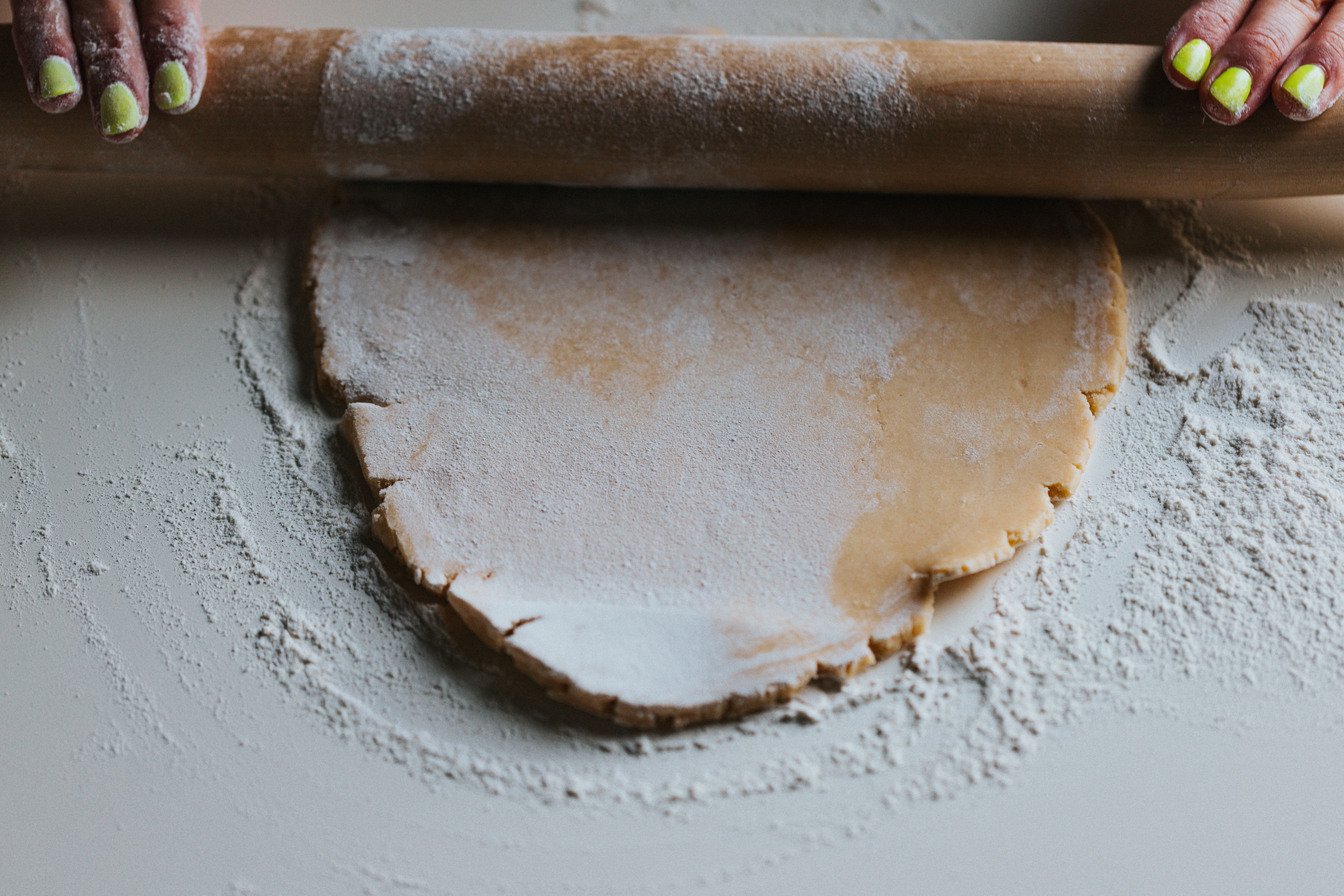
And yet, once again, six months after the disruption, I found myself standing at a counter top in a new kitchen with my hands in a bowl of dough. I was dicing up butter and mixing flour and salt to make a pie crust. As I kneaded the mixture, I had jazz playing on my phone. Rain wasn’t hitting the skylights, but instead, a child cooed with her father on the floor. My child. My husband. The man who helped me to bring life into the world.

I dared again to whisper, “I think I’m feeling happy again.”

There are moments that shake us, shape us, and leave us wondering who we will be next. Like snakes, we step out of shed skin that’s no longer needed and move into bigger versions of ourselves. Do snakes feel pain in the shedding? I believe humans do.

In the transformation, the movement of days into nights, and turning of months into years, we have a brave choice to believe we can be happy again. The process takes a long time, and yet, the formula seems so simple.

Surround myself with people I love, with simple ingredients, with time to stand at the counter. I can focus on the next big disruption, or I can focus on the pie crust and what it will mean for a simple dinner at home.

I’m whispering “I think I’m happy again” and that is a beautiful thing.

And a Squirt of Whipped Cream

Photo Courtesy of Unsplash

Losing someone is rarely easy. While their spirits may seem to evaporate into the liminal space, people we love who move on leave a lot behind. I spent much of this weekend amongst my grandmother’s things. Cups and wooden salad bowls, serving platters made of milk glass, worn handmade blankets and quilts, dishes with the farm scenes painted on ceramic.

While they moved her to assisted living weeks ago, they only took the essentials. Her navy blue, floral couch was gone, but the drapes that hung in her house for my whole childhood stayed. The china cabinet may have been picked over, but the sturdy structure still stood, watching us move through half-empty rooms, selecting what we hoped for and reminiscing at the dining room table. We flipped through photo albums and I saw faded pictures of relatives I’d never met nor heard of. Legends of old uncles with problems during prohibition, or ties to old business, were stuck among crinkly cellophane, protecting both stories and their sepia-toned faces.

As I lay on the floor in the basement, I said “You know what I hate about dead people? They never come walking through the door when you want them to.”

I knew my grandmother was going to pass. She lived a long life, close to ninety years. And yet, when I found out her spirit had moved on, it still felt as if all the air had been sucked out of the room. Maybe that’s what they do when they die – take the air with them into wherever comes next. It takes awhile to catch your breath.

This has been a summer of transition and shifting. We moved. We had a baby. We are growing into new roles and letting go of others. If all of your grandparents have passed, are you still a granddaughter? Or does that role now become my new daughter’s?

We’ll say good-bye in formal ways in a few weeks. And in the meantime, I’ll tuck a juice glass of her’s in my cupboard. In the morning, I’ll remember Lender’s bagels with blocks of cream cheese wrapped in foil, served on a small ceramic plate with a farm scene painted on top. I’ll remember Kraft singles, and dessert with Reddi-Wip out of a can. Because, as Grandma would say, life is better with a little squirt of whipped cream.

Being amongst her things, evoking memories, remembering stories, preparing to say good-bye, even when it hurts – all beautiful things.